Diana Al-Hadid: unbecoming

What does it mean to say a woman is “unbecoming”?
unbecoming is a survey of paintings and sculptures by Diana Al-Hadid that questions how constructions of femininity take form over time, a development that can be understood in part by thinking through Al-Hadid’s research and artistic practice. The artist’s reworking of materials and form is a process that models how one can similarly transform the social expectations about womanhood and women’s behavior to instead find the power in being “unbecoming.”
Based in New York, Al-Hadid works prolifically between painting, sculpture, and more recently, handmade paper. Born in Syria in 1981, Al-Hadid moved to the United States as a child. She grew up in Ohio, earned a Bachelor of Fine Arts from Kent State University, and a Master of Fine Arts from Virginia Commonwealth University. Al-Hadid’s work draws on diverse sources ranging from art history to Greek mythology, and global literature. Her visual language emerges from an astute sense of materiality that culminates in specific abstractions. The resulting works defy how we think about both materials and sculpture and in turn, work to unravel the ways of thinking we may see as “normal.”
The exhibition explores themes of gender and womanhood, aspects that are important yet often overlooked in Al-Hadid’s work. The artist draws on sources such as Hans Memling’s painting Allegory of Chastity (1475), which features a woman with a mountain built around her guarded by lions to protect her virtue and modesty. Al-Hadid also references Medusa, a woman in Greek mythology who has snakes for hair, often seen as the epitome of “unbecoming” because of both her temperament and her appearance. These are two examples of many in Al-Hadid’s work that reveal how art historical and mythological sources hold ideals about femininity that remain relevant to conversations about what it means to be a woman today.
In unbecoming, Al-Hadid invites us to look closely and consider how the materials in her work both break down and accumulate into their final form. In turn, we are prompted to reflect on how expectations about womanhood and femininity are similarly constructed but can also be deconstructed to imagine different futures.
unbecoming is organized by the Eli and Edythe Broad Art Museum at Michigan State University and curated by Rachel Winter, Ph.D., Assistant Curator, with support from Laine Lord, former Curatorial Research Assistant. Support for this exhibition is provided by the Eli and Edythe Broad Endowed Exhibitions Fund. The museum also extends a special thanks to Olney Gleason, New York, and Dieu Donné. Support for the accompanying publication Diana Al-Hadid: unbecoming is made possible by Olney Gleason, Lisa Applebaum, and April Clobes.
Dieu Donné is the leading non-profit cultural institution dedicated to serving emerging and established artists through the collaborative creation of contemporary art using the process of hand papermaking. Since 1976, Dieu Donné has introduced artists to the untapped potential of hand papermaking as an art medium. Through extensive collaborations with Master Papermakers, Dieu Donné works with artists from a wide variety of practices to explore the creative possibilities in hand papermaking – fostering experimentation and producing innovative works of art. Dieu Donné strives to teach a new visual language, providing a transformative experience that often leads to artistic breakthroughs.


-
 Diana Al-HadidHindsight, 2020Hand-drawn ballgrain plate lithograph on Essex paper39 x 68 in.
 -
Diana Al-HadidLionless, 2013Polymer gypsum, fiberglass, steel, wood, plaster, and pigment64 x 58 x 3 1/4 in.
-
Diana Al-HadidMood: 11:14am, 2024Polymer gypsum, fiberglass, steel, plaster, metal leaf, and pigment95 x 74 x 3 in.
-
Diana Al-HadidMother in the Middle, 2023Linen pulp paint and cotton blowout on abaca base sheet60 1/2 x 40 1/2 in.
-
Diana Al-HadidNight Medusa, 2023Linen pulp paint and cotton blowout on abaca base sheet30 x 40 in.
-
Diana Al-HadidSmoke Screen, 2015Polymer gypsum, fiberglass, steel, gold leaf, plaster, and pigment114 x 360 x variable in.
-
Diana Al-HadidUntitled, 2013Conté, charcoal, pastel, and acrylic on mylar24 x 18 in.
-
Diana Al-HadidAugust, after The Seventh, 2025Polymer gypsum, fiberglass, steel, plaster, gold leaf, and pigment109 x 85 x 6 in.
-
Diana Al-HadidMad Medusa, 2023Linen pulp paint and cotton blowout on abaca base sheet30 x 40 in.
-
Diana Al-HadidThere was and there was not. . . a clever woman in disguise, 2025Linen pulp paint and cotton blowout on abaca base sheet40 x 60 in.
-
Diana Al-HadidThere was and there was not. . . a foolish king, 2025Linen pulp paint and cotton blowout on abaca base sheet40 x 60 in.
-
Diana Al-HadidThere was and there was not. . . two sisters who lived in the trees, 2025Linen pulp paint and cotton blowout on abaca base sheet40 x 60 in.
-
Diana Al-HadidUntitled, 2014-2021Bronze3/4 x 32 x 30 in.
-
Diana Al-HadidUntitled (Mother Series), 2023Conté , charcoal, pastel, and acrylic on Mylar22 x 18 in.
-
Diana Al-HadidWarda II, 2024-2025Bronze36 x 27 x 16 in.


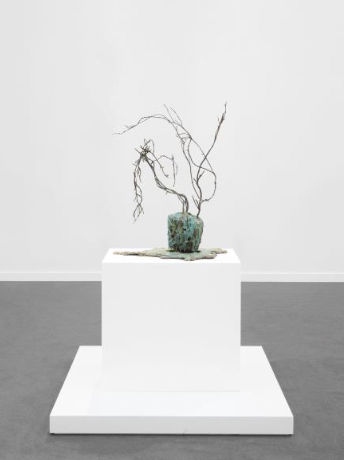


Diana Al-Hadid examines the historical frameworks and perspectives that continue to shape discourse on culture and materials today. With a practice spanning sculpture, wall reliefs, and works on paper, the artist weaves together enigmatic narratives that draw inspiration from both ancient and modern civilizations. Al-Hadid’s rich allegorical constructions are born from art historical religious imagery, ancient manuscripts, female archetypes, and folkloric storytelling.
Born in Aleppo, Syria in 1981, Al-Hadid lives and works between upstate New York and Brooklyn, NY. She received a BFA in Sculpture and a BA in Art History from Kent State University (2003); an MFA in Sculpture from Virginia Commonwealth University (2005); and attended the Skowhegan School of Painting and Sculpture (2007). She has been the recipient of a Joan Mitchell Grant, a New York Foundation for the Arts Grant, a Pollock-Krasner Grant, and the Academy of Arts and Letters Art Award. Her mosaic murals for NYC’s Penn Station were among 100 finalists for CODAawards. Al-Hadid has had solo exhibitions at the Eli and Edythe Broad Art Museum, East Lansing, MI, The Bronx Museum of the Arts, Bronx, NY, The Frist Art Museum, Nashville, TN, and San Jose Museum of Art, San Jose, CA. In 2018, the artist presented Delirious Matter, a solo exhibition of large-scale sculptures in Madison Square Park, New York, NY. Al-Hadid’s work can be found in numerous institutional collections worldwide, including the Whitney Museum of American Art, New York; the Museum of Fine Arts, Houston; and the National Museum of Contemporary Art, Athens, Greece, among others.
